


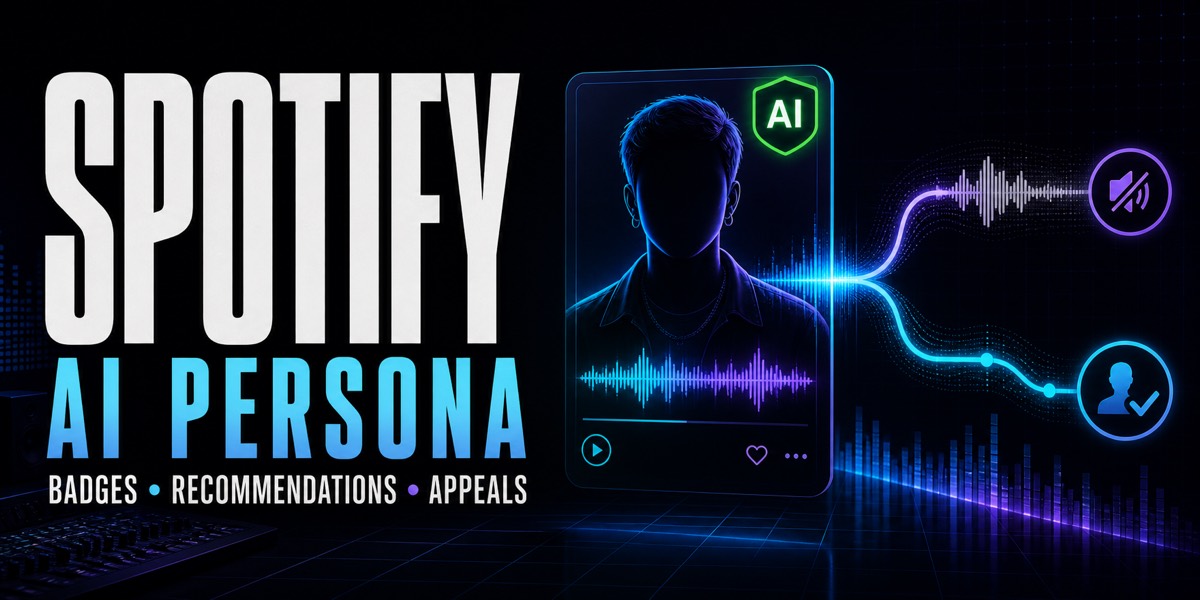
The short answer: Spotify’s AI Persona badge identifies an artist profile whose public identity may be AI-generated and may not represent a real person. It is not a blanket label for every track that uses AI. Starting in mid-September 2026, Spotify says labeled profiles will be excluded from editorial and algorithmic recommendations by default, although listeners who intentionally follow an AI Persona may still encounter its music. Artists can self-disclose, and profiles labeled through Spotify’s review process will be notified and given an opportunity to appeal.
The distinction between an artist’s identity and a track’s production process is the key to understanding the policy. A human artist who responsibly uses AI for lyrics, vocals, instruments, or production is not automatically an AI Persona simply because AI contributed to a song.
Spotify’s AI Persona Policy at a Glance
| Question | Current answer as of August 16, 2026 |
|---|---|
| What does the badge identify? | An artist profile whose public identity may be AI-generated and may not represent a real person |
| Does it label every AI-generated track? | No. The badge applies at the artist-profile identity level |
| When does it appear? | Spotify says the mobile rollout will begin in mid-September 2026 |
| Where will it appear? | Artist profile banner, About section, Search, and track rows in playlists |
| What happens to recommendations? | AI Personas are excluded from editorial and algorithmic recommendations by default |
| Can followers still hear the music? | Spotify gives following an AI Persona as an example of when its music may still be recommended |
| Is the music automatically removed? | Spotify has not announced an automatic takedown rule based only on the badge |
| Are royalties automatically canceled? | No such royalty cancellation rule has been announced as part of the badge policy |
| Can artists appeal? | Profiles labeled through Spotify review will be notified and can self-disclose or appeal |
| Does responsible AI-assisted creation make a human artist ineligible for verification? | No. Spotify says authentic human artists may use AI tools responsibly and remain eligible |
Spotify describes the badge in its announcement, Introducing a New Label for AI-Generated Artist Identities on Spotify. Because the feature has not yet completed its public rollout, exact availability may vary by account, market, device, and app version after launch.
What “AI Persona” Means—and What It Does Not Mean
An AI Persona is an identity-level disclosure. Spotify is asking whether the artist presented by the profile appears to be an actual, accountable person or group—not whether software touched any part of the recording.
The relevant profile signals can include the artist name, images, biography, social presence, public story, and the way the project represents the person or group behind the music. Spotify says its review will focus on profiles whose public identity appears to represent a photorealistic AI-generated identity, beginning with profiles that meet an audience threshold.
The badge does not, by itself, mean that:
- Every track on the profile was fully generated by AI;
- Spotify has detected a specific music-generation tool;
- The music infringes copyright;
- The artist committed fraud or impersonation;
- The catalog will be removed from Search or the artist page;
- Streams will stop generating royalties;
- A human creator is prohibited from using AI tools;
- Every unverified profile is an AI Persona.
Those questions are governed by different product features, platform rules, rights information, or enforcement processes.
What Happens to Music From an AI Persona
Excluded from recommendations by default
Spotify says it will not include AI Personas in editorial or algorithmic recommendations by default. That can affect discovery surfaces such as personalized recommendations, Radio, and Spotify-programmed playlists.
This is potentially more important than the visible badge. A profile can remain searchable while losing a meaningful source of non-follower discovery. For creators who depend heavily on algorithmic reach, the practical effect may be a change in the mix of streams rather than an immediate disappearance of all listening.
Followers may be treated differently
Spotify gives listeners who follow AI Personas as an example of an exception. That means the rule should not be summarized as “AI Persona music can never be recommended.” Intentional listener relationships may still influence what a follower sees or hears.
Until the rollout can be tested across markets, creators should avoid assuming that every recommendation surface uses exactly the same exception or that follower behavior will restore previous reach.
No announced automatic takedown or royalty ban
The AI Persona policy is a transparency and programming policy, not an announced automatic removal policy. Spotify has separate rules for spam, artificial streaming, deceptive content, unauthorized voice impersonation, and other violations.
A profile could therefore face enforcement for an independent policy violation, but the AI Persona badge alone should not be described as proof that a takedown or royalty cancellation will occur.
AI Persona vs AI Credits vs Verified by Spotify
Spotify now has several signals that answer different questions. Treating them as one universal “AI label” leads to incorrect conclusions.
| Spotify signal or process | Main question | Level | Typical consequence or purpose |
|---|---|---|---|
| AI Persona | Does the public artist identity represent a real person or accountable group? | Artist profile | Visible disclosure and default exclusion from editorial/algorithmic recommendations |
| AI Credits | Which part of a specific track was generated with AI? | Track contribution | Production transparency in Song Credits and Now Playing on supported mobile experiences |
| Verified by Spotify | Has Spotify reviewed this profile against authenticity and trust criteria? | Artist profile | Authenticity signal shown on the profile and in Search |
| Platform enforcement | Does content violate rules on spam, impersonation, artificial streaming, or deception? | Profile, release, or behavior | Investigation, restriction, removal, or another enforcement action depending on the violation |
Spotify’s AI Credits guidance says credits can identify AI-generated lyrics, vocals, instrumental performances, or production at the contribution level. They do not appear as an artist-profile label, and the absence of an AI credit does not prove that no AI was used.
Verified by Spotify addresses authenticity and trust. Spotify says profiles that primarily appear to represent AI-generated or AI-persona artists are not eligible, while real artists who responsibly use AI tools can still be eligible if they present themselves authentically.
Not seeing a Verified by Spotify badge is not evidence that a profile is AI-generated. Reviews happen on a rolling basis, and audience activity is one of the factors Spotify uses to prioritize eligible profiles.
Does AI-Assisted Music Make You an AI Persona?
Not automatically. Spotify’s published distinction is between the identity behind the artist profile and AI contributions within a track.
Consider these examples:
| Scenario | Likely policy layer | What the creator should focus on |
|---|---|---|
| A real singer uses AI mastering | Track production, if disclosure is supported and applicable | Accurate credits and an authentic artist profile |
| A human songwriter uses AI to draft part of the lyrics | Track-level AI contribution | Distributor-supported AI credits and documentation of human edits |
| A real producer uses a synthetic vocalist | Track contribution plus any voice-rights issues | Permission, accurate credits, and no deceptive identity claims |
| A fictional virtual band openly presented as fictional | Artist identity | Clear AI Persona disclosure and truthful profile language |
| A photorealistic “artist” is presented as a real person but no such person exists | Artist identity and possibly deceptive-content review | Correct the representation and prepare for AI Persona labeling |
| A human artist uses stylized or generated artwork | Context-dependent | Make the real person or accountable team behind the profile clear |
| An AI voice imitates a real artist without permission | Impersonation enforcement | Permission and rights—not merely an AI Persona disclosure |
Generated cover art, an AI-enhanced photo, or a virtual stage character does not provide a complete answer by itself. The overall representation matters: who the profile claims the artist is, whether listeners are being misled, and whether accountable people are clearly identified.
How Spotify May Apply the Badge
Spotify describes two routes.
Voluntary disclosure
Artists can disclose that their profile represents an AI Persona through Spotify for Artists. Voluntary disclosure is the clearest path for a fictional or generated identity that wants to avoid misleading listeners.
Spotify review
Spotify also plans to review relevant profiles rather than relying only on self-disclosure. It says the review will use internal tools and human judgment, initially prioritizing profiles above an audience threshold and examining public identity signals such as photorealistic generated imagery.
Spotify has not published a complete scoring formula, every evidence source it may consider, or a guarantee that all relevant profiles will be reviewed at the same time. Creators should therefore avoid trying to reverse-engineer a single image detector or assuming that one profile attribute determines the result.
What Creators Should Do Before the Rollout
1. Audit the identity presented by the profile
Review the artist name, banner, avatar, biography, About section, linked social accounts, website, concert information, merch, press materials, and distributor metadata.
Ask a simple question: Would a reasonable listener understand whether this artist represents a real person, a real group, a fictional character, or an AI-generated persona?
2. Separate identity disclosure from production disclosure
Do not use an AI Persona disclosure as a substitute for accurate track credits. Likewise, disclosing AI-generated vocals or lyrics does not answer whether the artist identity is fictional.
Keep the two records separate:
- Profile identity: who or what the artist is;
- Track production: which human and AI contributions created each recording.
3. Build an identity evidence file
Human artists and teams should keep evidence that supports the profile’s public representation, such as:
- Consistent official social profiles;
- A website with matching artist information;
- Press coverage or interviews;
- Performance, rehearsal, or studio documentation;
- Concert listings and ticket pages;
- Merch or label pages connected to the same artist;
- Distributor and label agreements;
- Contributor names and contact records;
- Source files for artist photos and artwork;
- A dated explanation of any fictional, virtual, or AI-generated elements.
This material does not guarantee a successful appeal, but it can make a correction request clearer and easier to assess.
4. Avoid misleading biographies and synthetic “proof”
Do not invent concert history, press quotes, hometown stories, collaborator credits, or behind-the-scenes images to make a generated identity appear human. That creates a broader trust problem and may implicate rules beyond the AI Persona label.
5. Preserve baseline performance data
Before the rollout, export or record your available Spotify for Artists data, including:
- Source of streams;
- Editorial playlist streams;
- Algorithmic playlist streams;
- Radio and autoplay traffic;
- Search and profile activity;
- Followers and active audience;
- Release-level impressions and engagement.
A baseline will help distinguish a real recommendation change from ordinary release cycles, seasonality, or audience decline.
How the Appeal Process Works
Spotify says an artist whose profile is labeled through its review process will be notified and given the opportunity to self-disclose or appeal. It has not yet published every operational detail of the final appeal workflow.
If you believe the label is incorrect:
- Read the notification carefully and use the official route it provides;
- State whether the profile represents a real person, real group, fictional project, or hybrid creative project;
- Identify the exact profile elements that may have created confusion;
- Provide concise, relevant identity evidence rather than an unorganized file dump;
- Explain any generated images, synthetic voices, virtual members, or AI-assisted production honestly;
- Correct misleading or inconsistent profile information where appropriate;
- Keep a copy of the submission, attachments, and dates;
- Avoid repeatedly changing the profile while the review is pending unless Spotify asks you to do so.
A useful appeal should be factual and narrow. For example:
This profile represents a real human artist. The artist name and catalog are managed by the person identified in the attached official website, distributor record, performance materials, and linked social accounts. AI tools were used for [specific contribution], but the profile does not claim that a generated person is a real artist. The image or biography element that may have caused confusion is explained below.
Do not claim that using any AI tool is irrelevant. The better argument is that the profile’s identity is authentic and that any AI contribution has been represented accurately.
What Listeners Can—and Cannot—Control
The badge gives listeners more context, but it is not currently a universal “block all AI-generated music” switch.
Listeners may be able to:
- See the AI Persona disclosure in supported Spotify surfaces;
- Choose whether to follow or intentionally play the artist;
- Interpret AI Credits for supported tracks;
- Report impersonation or other policy violations through the appropriate process.
The policy does not promise that every AI-assisted track will carry a profile badge, that every generated identity will be labeled immediately, or that listeners can apply one global filter to every possible use of AI.
How to Measure the Real Recommendation Impact
After the rollout begins, creators should evaluate evidence rather than relying on a single before-and-after screenshot.
Track at least four dimensions:
- Follower versus non-follower discovery: separate intentional audience activity from new-user recommendations;
- Editorial versus algorithmic sources: do not combine human-curated playlists, Radio, autoplay, and personalized playlists into one number;
- Search versus recommendation visibility: a profile can remain discoverable in Search while losing programmed exposure;
- Time and release effects: compare equivalent periods and account for new releases, campaigns, and normal volatility.
Document the app version, country, account type, date, surface, and whether the listener follows the profile. A test from one account should not be presented as proof of identical behavior in every market.
Frequently Asked Questions
What is Spotify’s AI Persona badge?
It is a profile-level label indicating that an artist’s public identity may be AI-generated and may not represent a real person. It does not automatically classify every track in the catalog as fully AI-generated.
When will Spotify start showing AI Persona labels?
Spotify says the rollout will begin on mobile in mid-September 2026. Availability may be phased by market, account, app version, or interface surface.
Does Spotify ban AI music?
No blanket ban was announced. The new policy labels certain artist identities and excludes them from editorial and algorithmic recommendations by default. Separate policies still apply to spam, fraud, impersonation, artificial streaming, and prohibited content.
Will AI Persona music stop earning royalties?
Spotify has not announced an automatic royalty cancellation triggered solely by the badge. Reduced recommendation exposure could affect listening volume, but that is different from a rule canceling payment for eligible streams.
Will AI Persona music disappear from Discover Weekly and Radio?
Spotify says AI Personas will be excluded from editorial and algorithmic recommendations by default. The exact behavior of every surface should be retested after rollout, especially for listeners who already follow the profile.
Does using Suno, Udio, AI mastering, or AI lyrics make me an AI Persona?
Not automatically. AI Persona concerns the artist identity presented by the profile. AI use within lyrics, vocals, instruments, or production belongs to the track-contribution layer and may be disclosed through AI Credits where supported.
Can a human artist who uses AI still get Verified by Spotify?
Spotify says yes, provided the artist presents themselves authentically and otherwise meets the relevant standards. Responsible AI-assisted creation is not, by itself, the same as presenting a generated identity as a real person.
What is the difference between AI Persona and AI Credits?
AI Persona describes the artist profile’s identity. AI Credits describe specific AI-generated contributions to a track, such as lyrics, vocals, instrumental performance, or production.
Can an artist appeal an AI Persona label?
Spotify says profiles labeled through its review process will receive a notification and can appeal. Follow the official route in that notification and provide concise evidence about the real person or accountable team behind the profile.
Does the absence of a Verified by Spotify badge mean an artist is AI?
No. Verification reviews happen over time, and Spotify considers listener activity and other eligibility signals. An absent verification badge does not prove that a profile represents an AI Persona.
Is there a Spotify setting to block all AI-generated music?
The AI Persona policy is not a universal AI-music filter. It affects labeled artist identities and their default recommendation eligibility; it does not identify or block every possible AI-assisted track.
Bottom Line
Spotify’s AI Persona badge draws a line between who an artist claims to be and how a song was produced. The most important announced consequence is default exclusion from editorial and algorithmic recommendations—not automatic removal, a royalty ban, or a judgment about every AI-assisted track.
Human artists should make their identities clear, keep accurate production credits, preserve supporting evidence, and monitor recommendation sources after rollout. Fictional or generated artist projects should disclose that identity honestly rather than attempting to look like an undisclosed real person.
This article was last verified on August 16, 2026. It should be updated after the mid-September rollout with live screenshots, final appeal instructions, regional availability, and reproducible recommendation tests.