


If you have been generating AI music for a while, you have likely hit the "AI Plateau."
The melodies are technically correct, but they lack surprise. The structures are flawless, but completely unmemorable. You generate a track, think "that’s okay," and immediately forget it.
Why does this happen? Did the AI models get worse? Not at all. The problem lies in the nature of generative AI itself: Probability.
When you input standard prompts like "sad emotional pop piano," the AI searches its latent space for the most statistically safe, middle-of-the-road musical decisions. It avoids risks. It gives you the mathematical average of a million pop songs.
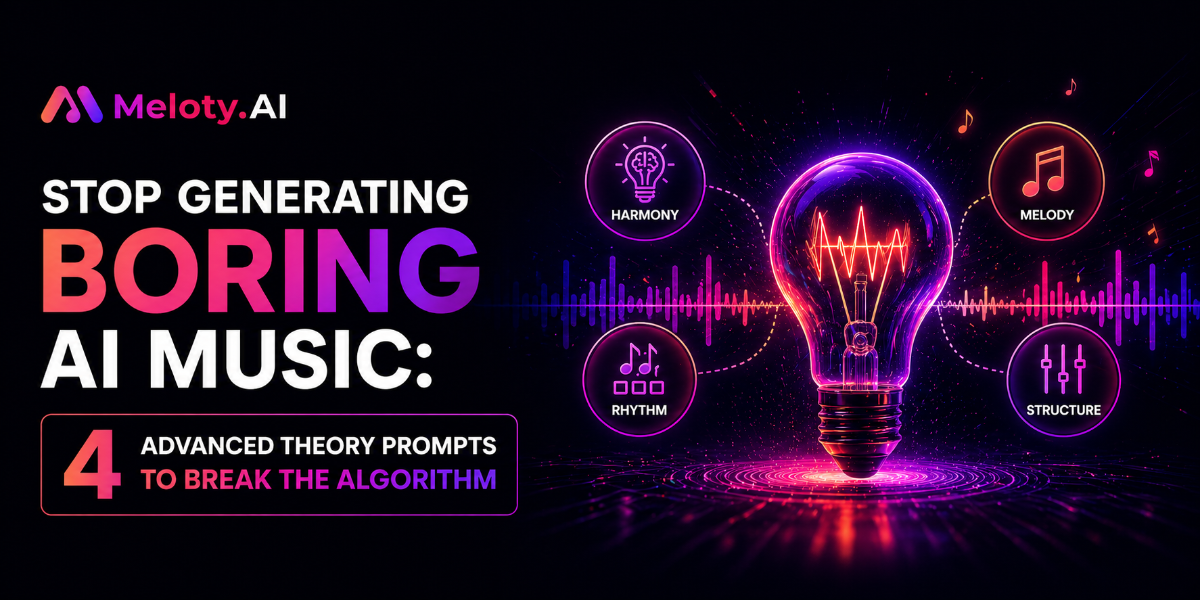
To break the algorithm and generate tracks that actually sound human, unpredictable, and commercially viable, you have to stop prompting with "vibes" and start prompting with Music Theory.
Here are four advanced theory techniques to force your AI generator out of its comfort zone.
1. The Rhythm Disrupter (Time Signatures & Syncopation)
Most AI music defaults to a standard 4/4 time signature. It is safe, predictable, and ultimately boring to the human ear. To instantly make a track sound more sophisticated, you must destabilize the rhythm. The human brain craves the slight tension of irregular patterns.
Keywords to inject into your prompt:
-
[7/8 time signature]or[5/4 odd meter] -
[Heavy syncopated bassline] -
[Polyrhythmic percussion] -
[Rubato intro](forces the AI to play with a flexible, free-flowing tempo)
Result: The beat will start to swing and hesitate. This instability instantly removes the "robotic" grid-like feel of basic AI tracks.
2. The Harmonic Hack (Dissonance & Modulation)
AI loves the safety of major and minor triads (the standard 4-chord pop loop). If you want to create emotional depth or tension, you have to break the loop by introducing unexpected harmonic changes.
Keywords to inject into your prompt:
-
[Dissonant jazz voicings, complex extensions] -
[Unexpected modulation to relative minor] -
[Diminished passing chords] -
[Specific progression: ii-V-I with tritone substitution]
Result: The melody will deviate from the expected path. That slight feeling of "unresolved tension" is the core of musical storytelling.
3. Dynamic Contouring (Micro & Macro Expressions)
A major flaw in basic AI generation is the "brick-wall" dynamic—the song is loud and intense from the first second to the last. Real music breathes. You need to direct the performance dynamics explicitly in your lyric meta-tags.
Micro-dynamics (Vocal Textures):
-
[Vocal: airy and breathy, close-mic] -
[Vocal: aggressive vocal fry] -
[Vocal: powerful belted crescendo]
Macro-dynamics (Song Structure):
-
[Arrangement: sparse acoustic intro] -
[Arrangement: explosive wall-of-sound drop] -
[Sudden total silence before chorus]
Result: The song stops broadcasting and starts performing.
4. Latent Space Collision (Genre Clashing)
When creators mix genres, they usually pick safe combinations like "Pop-Rock" or "Synth-Pop." To discover truly unique sounds, you need to force the AI to combine genres that sit on completely opposite sides of its training data.
Try combining completely contradictory styles:
-
"90s Seattle Grunge mixed with Brazilian Bossa Nova"
-
"Cyberpunk darksynth with Gregorian chant vocals"
-
"Trap beats combined with Appalachian bluegrass banjo"
Result: The AI is excellent at fusing elements but terrible at deciding which elements to fuse. By forcing a bizarre collision, you bypass the "safe zone" and generate highly creative, unpredictable textures.
The Professional Upgrade: Why Theorists Use Meloty.ai
Understanding music theory gives you a massive advantage, but typing out complex chord progressions and time signatures manually is exhausting.
This is why professional producers have migrated to Meloty.ai.
Instead of guessing how an AI engine will interpret "diminished chords," Meloty integrates frontier LLM Agents (like DeepSeek V4 Pro and ChatGPT 5.5). You can simply tell your Producer Agent: "Write a prompt for a jazz-hop track that starts in 4/4 but switches to 7/8 in the chorus, using dark, dissonant chords."
Our Unified Agent will translate your vision into the exact technical meta-tags the music engine needs.
Furthermore, true musical dynamics are best controlled in the mix. Meloty allows you to download 12-track audio stems and MIDI files. You can generate that complex jazz progression, download the exact MIDI data, and tweak every single note or chord voicing in your DAW.
Stop letting probability dictate your art. Take back control with advanced theory, Agent-driven prompts, and stem downloads on [Meloty.ai] today.